Beyond the Pink Ribbon: How Dr. Jackie Turns Survival Into Care
A physician, a two-time breast cancer survivor and an advocate whose mission is widening from personal comfort to better health and access for women.

Long after the pink ribbons are put away, a person living with cancer still has to meet the morning. There are appointments to keep, changes in the mirror to absorb, families to reassure and the private task of learning to recognize oneself again. Dr. Jacqueline Walters, known to television audiences as Dr. Jackie, understands that reality from two vantage points: the examining room and the patient’s chair.
To viewers of Bravo’s Married to Medicine, Dr. Jackie is the poised Atlanta obstetrician-gynecologist whose composure has become part of the show’s identity. But beneath the familiar television presence stands an accomplished physician who has survived breast cancer twice and chosen to make the experience useful to others. What distinguishes Dr. Jackie is not the fact that she can speak movingly about resilience. It is the determination to turn that experience into sustained service, from helping women feel like themselves during treatment to speaking publicly about the quality of care they deserve.
The conviction behind 50 Shades of Pink
It began not with a runway spectacle, but with the wish to make other women feel seen. In 2012, before the charity was formally established, Dr. Jackie hosted the first 50 Shades of Pink luncheon for breast cancer survivors. Dr. Jackie later remembered the women sharing stories, laughing and walking a pink carpet. The lunch offered something medical appointments alone could not: a public celebration of people whose lives were so often discussed only in terms of diagnosis and treatment. The foundation followed in 2013, giving this instinct for fellowship and reassurance a sustained charitable home.
Dr. Jackie established the 50 Shades of Pink Foundation in 2013 with a mission to nurture the physical, emotional and spiritual well-being of people affected by breast cancer. The foundation’s language about inner and outer beauty carries a specific meaning when seen through the experience of treatment: hair loss, fatigue, altered body image and the strain of repeated appointments can unsettle a person’s sense of identity. Dr. Jackie understood that dignity can be restored in small, tangible ways — and that no one should have to wait until treatment ends to feel worthy of care.
The foundation translated that belief into gift baskets for people undergoing chemotherapy, survivor-centered fundraising and gatherings that celebrated people as more than their diagnoses. In a Bravo essay, Dr. Jackie described buying for other patients the things that had helped during her own surgeries, chemotherapy and radiation. The instinct was intensely practical: instead of offering only sympathy, Dr. Jackie asked what might make a difficult day gentler.
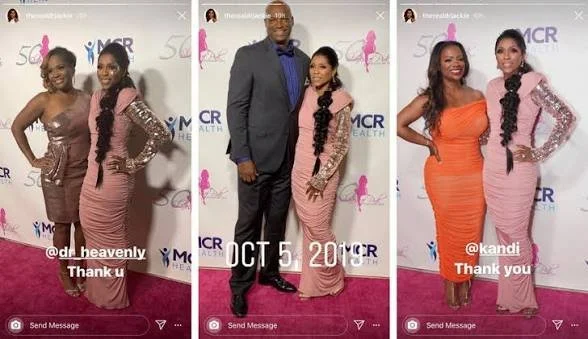
Over the years the foundation also created occasions for the wider community to show up. At its 2016 gala, 20 breast cancer warriors walked a fashion runway; the 2018 gala brought supporters and survivors together at Atlanta City Hall for a fashion show and fundraiser. Dr. Jackie’s achievement was to place women confronting disease at the center of an event traditionally associated with glamour. The spectacle was not the point. Visibility was: a reminder that illness does not take away anyone’s right to beauty, celebration or belonging.
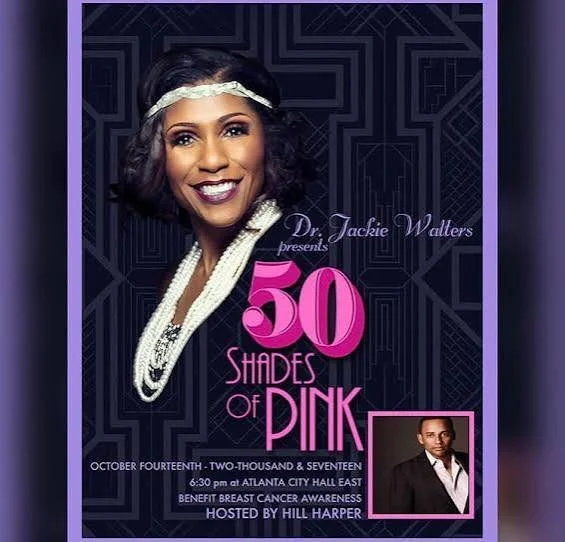
The evolution is visible in the archive. On October 14, 2017, Dr. Jackie presented the fifth annual 50 Shades of Pink gala and fashion show at Atlanta City Hall, with actor and author Hill Harper as host. A Great Gatsby-style evening placed survivors and supporters on the runway. Contemporary reporting described an auction to sponsor comfort gift baskets, as well as a $20,000 contribution announced by Atlanta Mayor Kasim Reed. By 2018, the fundraiser was in its sixth year. What began as one luncheon had become a recurring public occasion that paired celebration with material support.
The foundation’s reach extends beyond women in active treatment. In a 2023 interview with The Atlanta Journal-Constitution, Dr. Jackie described wanting relatives, friends and other survivors involved in the journey. That year’s sold-out foundation luncheon featured fellow survivor Guerdy Abraira in a panel conversation. These are meaningful choices. A diagnosis changes the emotional landscape of a household, and caregivers often need language, company and reassurance of their own. Dr. Jackie’s approach recognizes the circle of people who travel alongside the patient.
The gift of being seen and seeing someone else
There is a quietly radical quality to Dr. Jackie’s insistence that confidence matters during illness. Some survivors are ready to speak publicly; others simply want to get through treatment privately. Some choose lipstick and a beautiful outfit for appointments; others do not have the energy. Dr. Jackie’s example is not a prescription to remain cheerful. It is an invitation to retain whatever pieces of identity help a person feel whole, without shame or apology.
Her support has also become personal beyond the foundation’s organized events. In a 2025 Bravo interview, Dr. Jackie explained reaching out to Guerdy Abraira after learning about her breast cancer diagnosis. What began as a connection through reality television became, in Dr. Jackie’s telling, an act of sisterhood: one woman who understood the fear offering companionship to another. Such gestures can be difficult to measure, but the distinction matters. Advocacy becomes most persuasive when it is visible not only at a gala or behind a microphone, but in the willingness to call, listen and stand beside someone.

A physician with substance behind the spotlight
The credibility of Dr. Jackie’s advocacy is strengthened by the professional life beneath it. Dr. Jackie earned science degrees from the University of Mississippi and Alcorn State University and a medical degree from the University of Mississippi School of Medicine.
Dr. Jackie completed an obstetrics-and-gynecology residency in 1997 through the Medical Center of Central Georgia and Mercer University, then built a career in private practice in the Atlanta area. Nearly three decades of work in women’s healthcare make Dr. Jackie’s public voice more than a celebrity endorsement of a cause.
At Comprehensive Women’s OB/GYN, Dr. Jackie works in a specialty that accompanies patients through many of the most consequential stages of their lives: reproductive decisions, pregnancy, preventive screenings, gynecologic symptoms, menopause and aging. These are deeply personal areas of medicine, where communication can be as important to a patient’s experience as clinical knowledge. Dr. Jackie has consistently spoken about a mind-body-spirit approach while practicing conventional medicine a useful acknowledgment that patients arrive with fears, responsibilities and histories as well as symptoms.

Professional effectiveness deserves to be discussed carefully: no public biography can establish an individual doctor’s outcome statistics or prove the quality of every clinical encounter. What is demonstrable is Dr. Jackie’s medical training, sustained clinical practice, patient-education work and willingness to use a public platform to clarify medical decisions. Dr. Jackie has made complex topics less intimidating without asking audiences to treat a television personality as a substitute for their own physician.
Dr. Jackie’s public influence has also drawn recognition beyond entertainment and the clinic. In 2026, Georgia lawmakers introduced House Resolution 1601 to recognize her work as an obstetrician-gynecologist, author and founder of 50 Shades of Pink. The measure speaks to her visibility in women’s health; it should not be confused with a formal evaluation of treatment outcomes.

That educational instinct appeared clearly in a 2019 Good Morning America segment, when Dr. Jackie accompanied a woman through a first mammogram. Instead of merely repeating the importance of screening, Dr. Jackie helped viewers see how the process works and how a supportive clinician can reduce uncertainty. The moment captures something admirable about her public service: she takes the anxiety around healthcare seriously and tries to answer it with practical information.
Dr. Jackie has also used a book, The Queen V, and appearances beyond the clinic to encourage conversations around sexual and reproductive health that are too often postponed or surrounded by embarrassment. Her most valuable public attribute may be this balance: confidence without dismissiveness, sophistication without distance, and a readiness to make people feel more informed before they enter a medical conversation.
A larger mission: Black women’s health and the question of access
In August 2025, Dr. Jackie said she was reimagining the 50 Shades of Pink Foundation so its attention could reach beyond breast cancer to wider questions of Black women’s health, including education, confidence and access. It is a thoughtful expansion of the original mission. If the foundation began with the needs Dr. Jackie understood as a survivor, its next horizon acknowledges the inequities that can affect women long before a cancer diagnosis and long after treatment.
The urgency is real. The American Cancer Society reports that Black women in the United States are 38 percent more likely to die from breast cancer than White women, despite a slightly lower incidence of the disease. The figure reflects a larger set of challenges, including differences in timely diagnosis, treatment access and quality of care. Dr. Jackie did not create these inequities, and no single foundation can remedy them. But a physician who knows both the clinical setting and the lived experience of serious illness is well placed to push the conversation toward earlier attention, better information and fairer access.

This direction makes Dr. Jackie especially compelling as an advocate. She is not limiting the meaning of empowerment to self-confidence, although confidence remains central to her work. Dr. Jackie is connecting how a woman feels to whether a woman can obtain, understand and follow through on the care she needs. In that wider mission, the kindness of a gift basket and the seriousness of health-system reform can belong to the same story.
Speaking up for the people who deliver care
Dr. Jackie’s advocacy also includes the professionals who spend their lives looking after others. At the U.S. Chamber of Commerce’s April 2026 Health Summit, Dr. Jackie appeared in a session on strengthening patient outcomes. In its post-event reporting, the Chamber highlighted Dr. Jackie’s discussion of women in healthcare and burnout in the healthcare workforce. The topic is not separate from patient wellbeing: clinicians need time, resources and sustainable working conditions to give thoughtful care.
It is an important extension of Dr. Jackie’s voice. The best public health advocates understand that compassionate medicine cannot depend indefinitely on exhausted individuals. By bringing the perspective of an experienced OB-GYN into a national conversation about the healthcare workplace, Dr. Jackie connects the intimate world of the consultation room to the systems that shape it. She makes space not only for the person seeking help but also for the person trained to provide it.
The next conversation: knowing what cancer treatment is treating
One of Dr. Jackie’s most recent documented breast-cancer appearances came on June 22, 2026, when Dr. Jackie joined Good Morning America for a segment presented with sponsor Pfizer. Drawing on the experience of surviving cancer twice, Dr. Jackie emphasized the importance of biomarker testing. It was a timely shift from the familiar message of finding cancer early toward another essential question: once cancer is diagnosed, what characteristics of that cancer might influence the treatment plan?

In breast cancer, tests for estrogen receptors, progesterone receptors and HER2 status can help medical teams characterize disease and consider appropriate treatments. The choices depend on the patient’s diagnosis and clinical circumstances; not every biomarker test is necessary for everyone. The larger message is one Dr. Jackie has earned the authority to deliver with clarity: patients can ask their clinicians to explain their results, what those results mean and why a particular therapy has been recommended.
It is here that the different chapters of Dr. Jackie’s work come together. The 50 Shades of Pink Foundation has treated emotional comfort as a legitimate part of the cancer experience. Her medical career and educational appearances bring attention to informed decisions and communication. Her widening interest in Black women’s health demands that those conversations reach more people, not merely those with the strongest networks or the greatest resources. The result is an advocacy that is gracious in its tone but increasingly substantial in its ambition.
An invitation to continue the work
Dr. Jackie’s legacy should not be reduced to being an inspirational survivor on television. Dr. Jackie has made a deliberate choice to return to the places where fear and uncertainty begin — clinics, support networks, public conversations — and use hard-won experience to make them more humane. Her combination of medical training, public candor and personal generosity makes her a deserving subject for Breast Cancer Awareness Month, and an example of what it looks like when visibility is treated as a responsibility rather than an achievement in itself.
The most relevant next step this October is to follow the work Dr. Jackie is actively discussing now: the widening mission for Black women’s health and the 2026 conversation about understanding cancer biomarkers. The video is available for readers to watch, and the questions it raises can be carried into conversations with a qualified healthcare professional. For readers moved by the survivor-support mission, Dr. Jackie’s official links provide a starting point for following foundation activity and future opportunities to engage. No new foundation event date has been verified for this edition.
WATCH THE 2026 INTERVIEW Good Morning America: Dr. Jackie and biomarker testing
LEARN WHAT TO ASK Understand breast cancer receptor and biomarker tests
FOLLOW THE FOUNDATION Dr. Jackie’s official links and updates